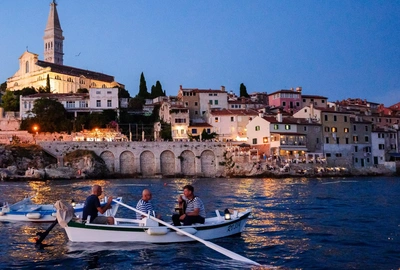
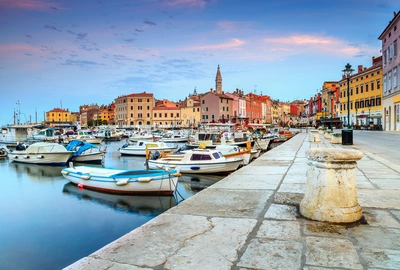
If you've seen one photo of Rovinj, you've seen St. Euphemia's bell tower — the tall, slim Venetian-style spire that crowns the peninsula and points the sky from every angle of the old town. It's the tallest thing in Rovinj, the first landmark you spot from the harbour, and the last piece of the skyline to catch the evening light.
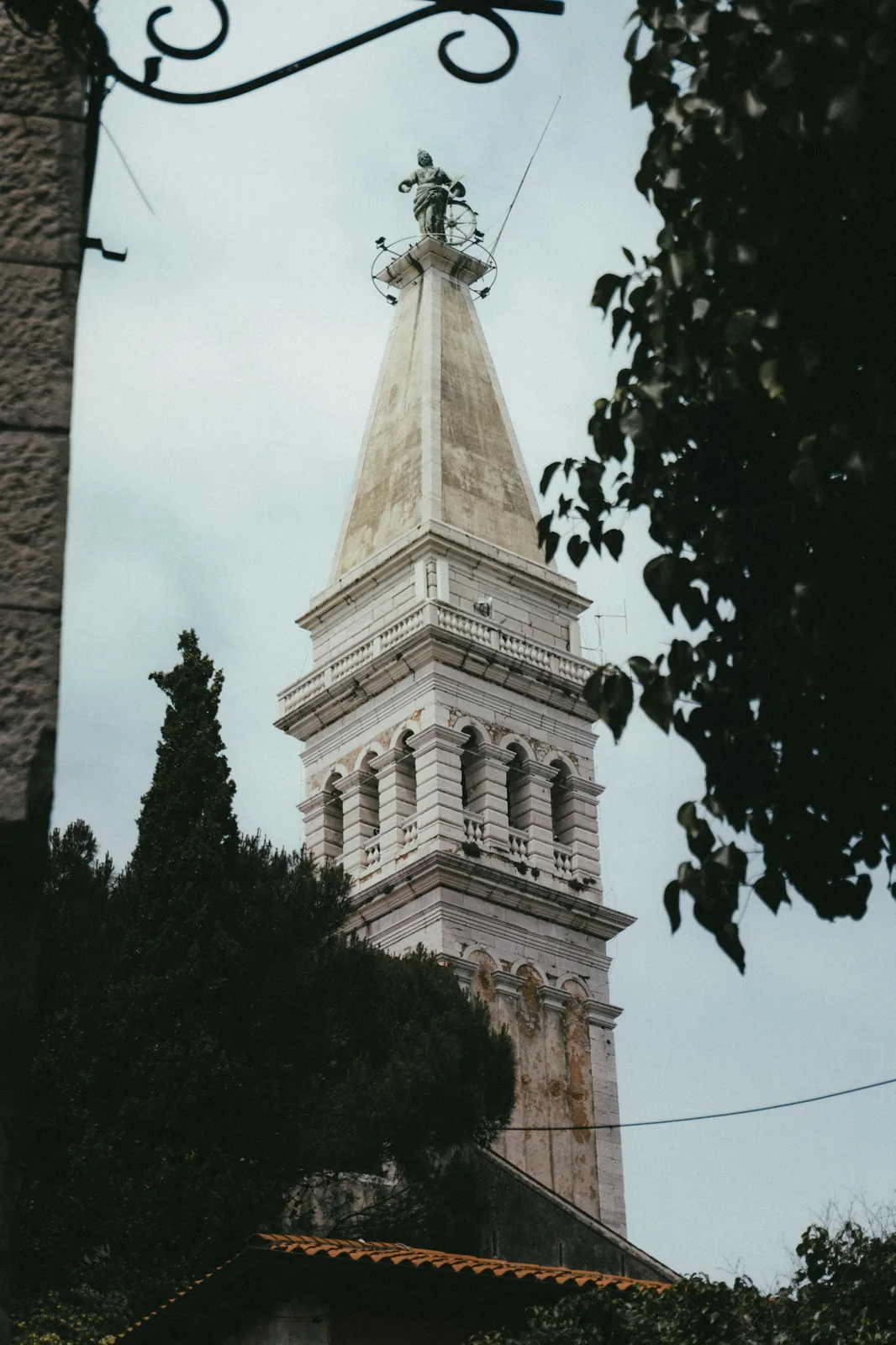
But what most people don't realise is that the church underneath it is one of the finest examples of Istrian coastal Baroque in existence, and its story — from a miracle-working sarcophagus that drifted ashore in 800 AD to a copper statue that still rotates with the wind — is pure Mediterranean legend. Here's how to visit both, and what to look for once you're inside.
Quick take
- The church is free to enter; the bell tower climb has a fee.
- The tower is about 60 m tall. The climb is 200+ narrow wooden stairs, open-tread and see-through — not for anyone with a fear of heights. For everyone else, the view is spectacular.
- Open daily in season (spring–autumn), more limited hours in winter.
- The statue of St. Euphemia on top rotates with the wind — locals used it as a weather forecast long before phones.
- Patron saint's feast day: 16 September — a town-wide celebration, and the best day to visit if you like living tradition.
The bell tower (and its wandering saint)
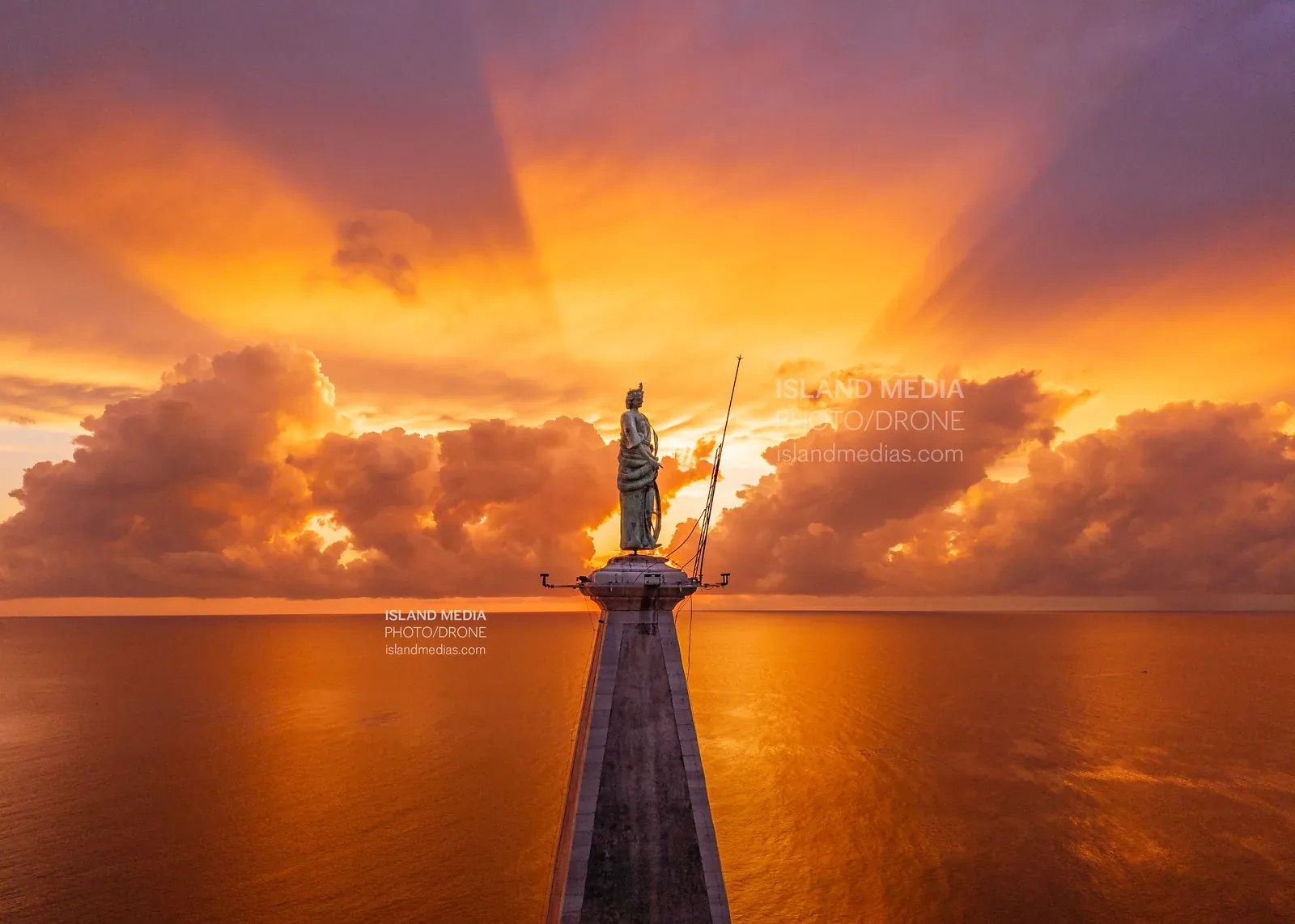
The tower you see today isn't the original. A smaller, ruined bell tower stood on this spot for centuries before the Rovinj authorities commissioned a new one from a Milanese architect, Alessandro Manopola. Construction began on 7 October 1654 and — with another Milanese, Cristoforo Bellan, finishing the job — it was completed in 1687. Thirty-three years of stonemasonry for something that's stood for 340 years since.
It's classically Venetian in form, borrowing the visual grammar of St. Mark's Campanile in Venice: a long vertical shaft, a loggia for the bells about two-thirds up, a balustrade above, and a pointed tip. Local architectural historians still call it one of the most beautiful bell towers in all of Istria.
On top sits a 4.7-metre copper statue of St. Euphemia, hammered into shape in 1758 by the Vallani brothers from Maniago. She replaced an older wooden statue that had been destroyed by lightning, and she's been up there ever since — pulled down only once, in 1993, for a full restoration. Her great trick: she stands on a shaft and rotates freely with the wind. When the weather is fair, she turns to face the open sea to the west — watching over the fishermen out on the Adriatic. When a storm is coming in, she turns inland to face the town, shielding Rovinj with her chest.
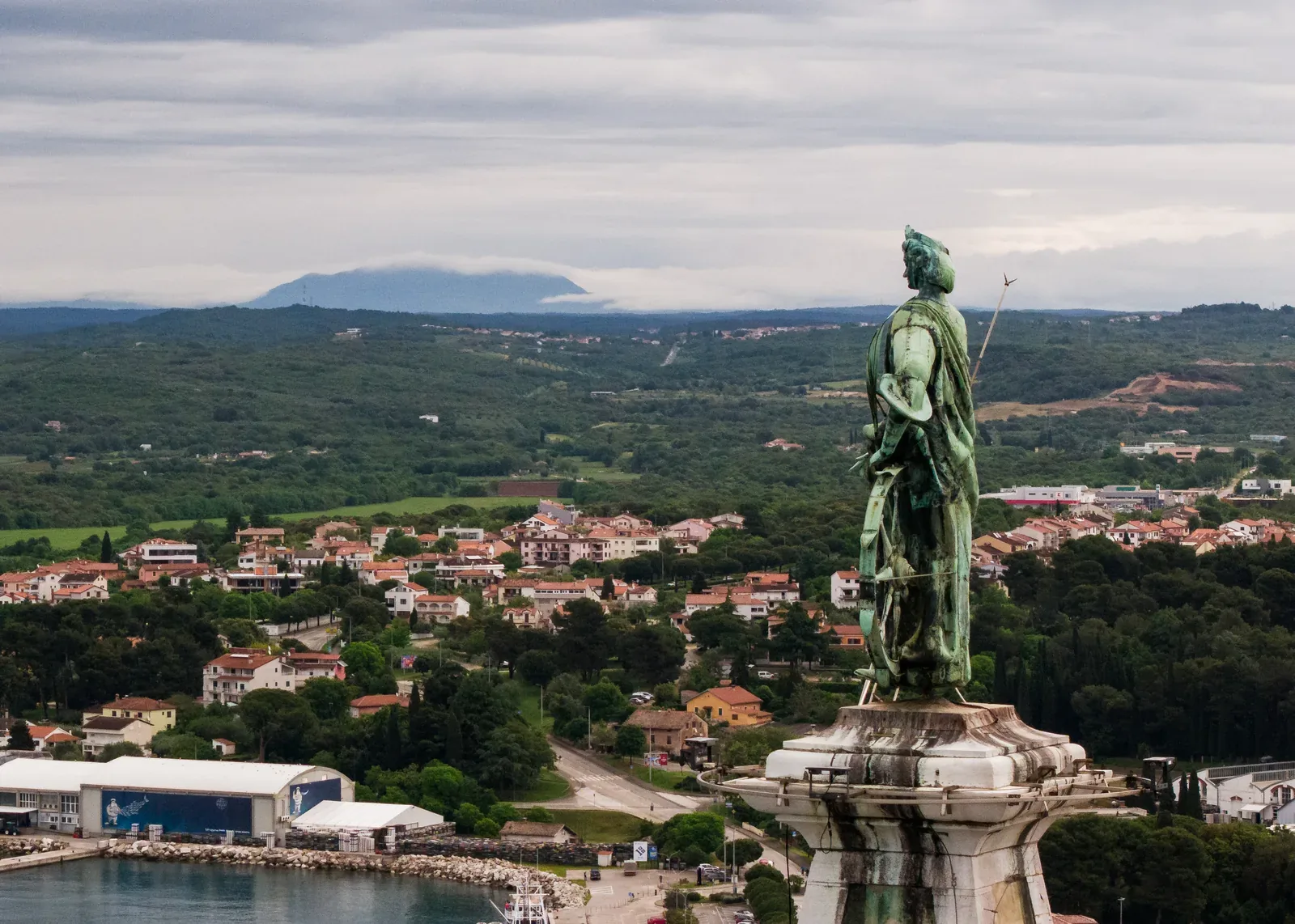
There's a local story about why she turns away from Katarina specifically in storms. According to the old Rovinj women, St. Euphemia and St. Catherine once loved the same man — and he chose Catherine. So when the weather sours, Euphemia turns her back with a curt "Rangite!" — Rovinj dialect for "You're on your own!"
The three bells you can hear ringing across town are modern: they were cast in Innsbruck in 1994–95. But one of the original Venetian bells, cast in 1794 by the Canciani family in Venice, is still kept inside the church as a relic.
Climbing the tower
The climb is up an old wooden staircase that hugs the inside of the shaft — narrow, steep, and open-tread (you can see through the steps). There's no lift, no switchback, just 200-plus stairs, and the odd window to catch your breath. It isn't physically hard — plenty of grandparents make it up — but the see-through steps and the height make it a proper test of nerves. If you have a fear of heights or vertigo, skip it. For everyone else, the view at the top is worth the nerve.
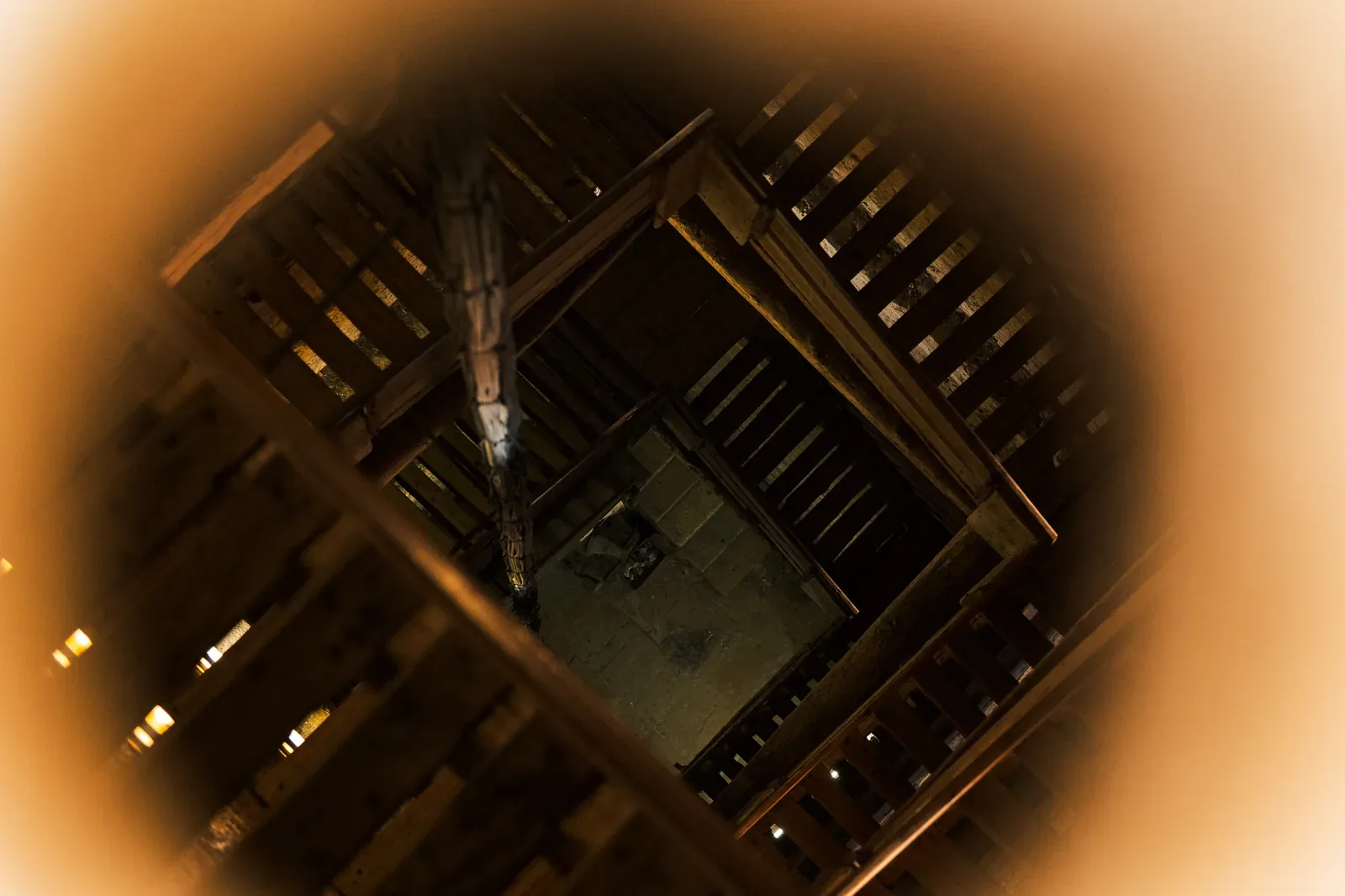
One more thing: avoid going up at noon. The bells are loud at street level — at the top of the tower, a metre from the bronze, they're physically uncomfortable. Check the time before you start climbing.
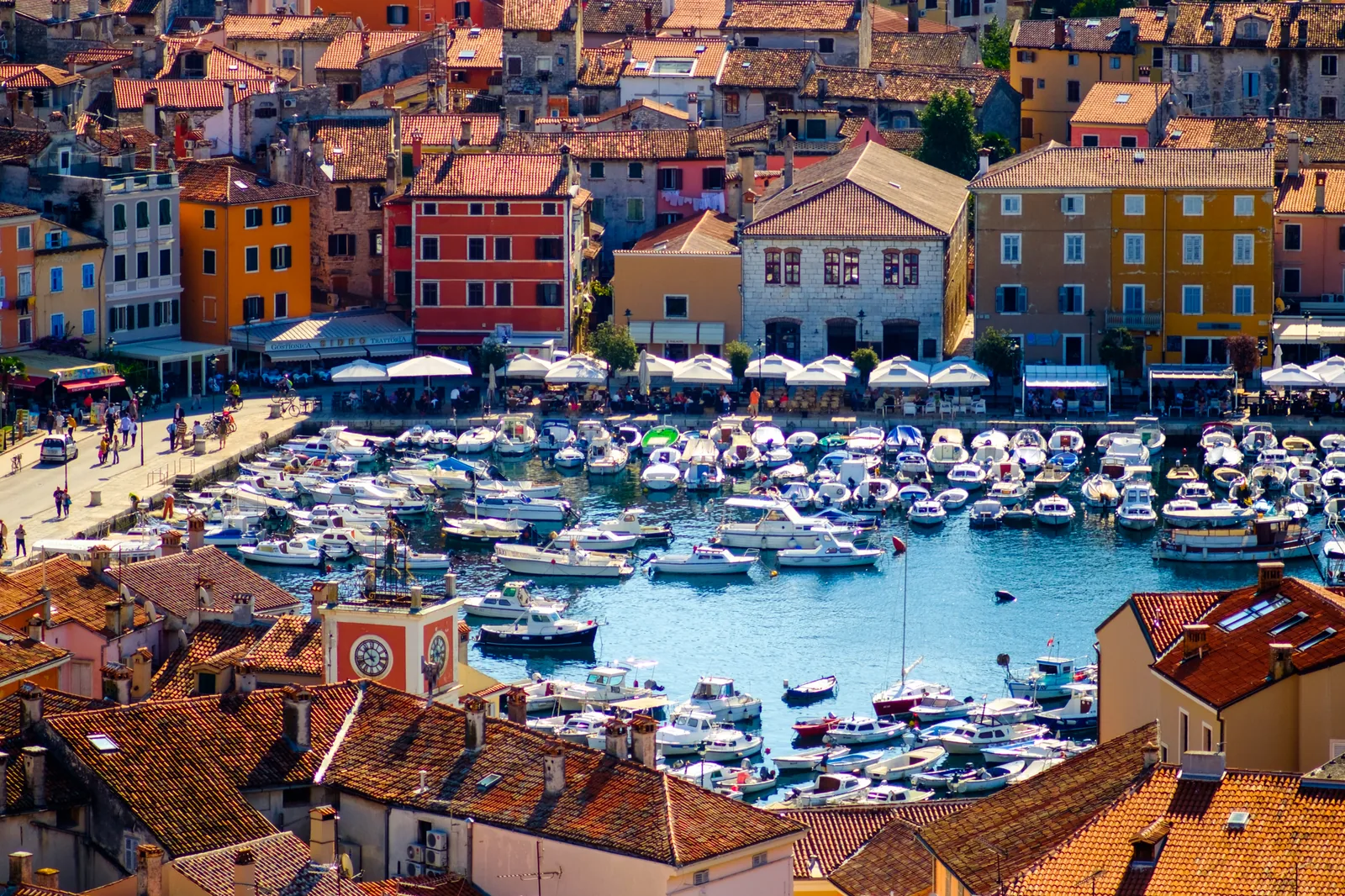
What you get at the top: a 360-degree view of the whole peninsula, the harbour and ACI marina to the east, the 22 islands of the archipelago to the west (you can see Sveta Katarina and Crveni Otok clearly), the Punta Corrente forest park to the south, and on a clear day the Učka mountains far to the east across the Adriatic.
The church
The bell tower gets the postcards, but the church is the main event. Step inside and you're in a piece of 18th-century Venice.
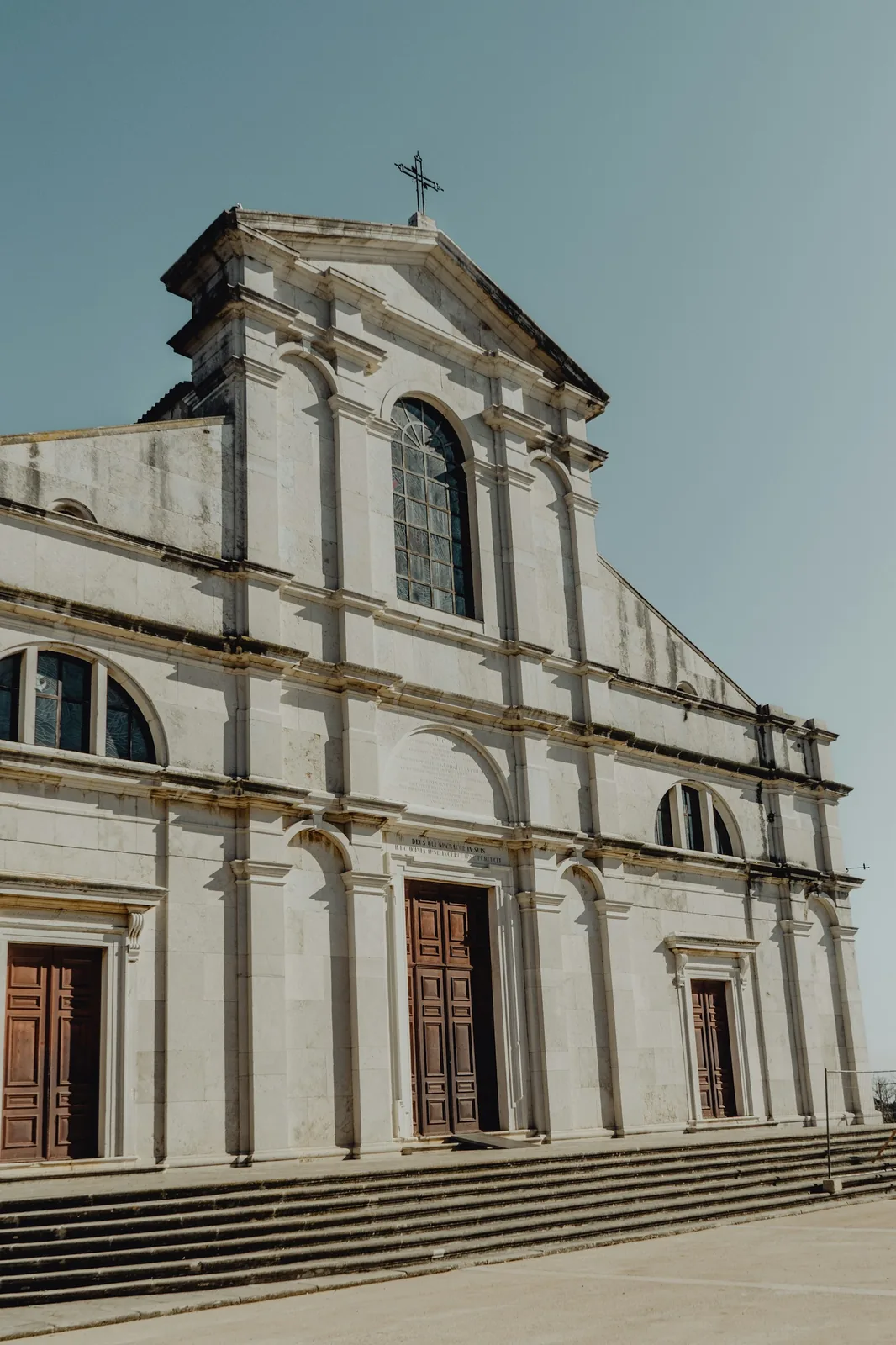
There's been a church on this hilltop for over 1,000 years. The original was a small single-nave building dedicated to St. George — whose name still appears in the church's full dedication. After the saint's body supposedly floated ashore in 800 AD (more on that below), a three-nave church was built around it in the mid-10th century.
By the 1600s Rovinj was booming — fishing, shipping, trade with Venice — and the old medieval church felt too small. Work on the new, grander Baroque church began on 8 December 1720, designed by the Venetian architect Giovanni Scalfarotta. When Scalfarotta's design hit budget trouble, another architect, Giovanni Dozza, took over and finished the construction in 1736. The facade came much later — built between 1861 and 1865 by the local Rovinj architect Giacomo Depozza.
The numbers give you a sense of scale:
- Length: 51.11 m
- Width: 30.26 m
- Height of the central nave: 17.71 m (lateral naves 10.11 m)
- Three naves separated by two sets of six arcades on five stone pillars
Historians class it as the most important example of Istrian coastal Baroque architecture. Inside, it's all grey stone, arcades, and seven altars richly decorated by Venetian masters.
What to look for inside
- The sarcophagus of St. Euphemia behind the altar dedicated to her — made of Proconnesian marble in Aquileia around the 3rd–4th century AD. Through a small glass window in the side of the tomb you can see her body, with a wax mask over her face that was made in 1953 by the Hungarian artist Mila Vod. Her left arm is missing — legend says the Venetians kept it at their church of St. Kancian after the Genoese returned her relics at the end of the Genoese–Venetian War (1378–1381).
- The main altar (1739–1741) by Venetian master Giacomo Laureato, with statues of St. George slaying the dragon, St. Mark with his lion, and St. Roch with his dog, sculpted by Alvise Tagliapietra (Venice, 1670–1747) and his son Ambrogio.
- Above the main entrance, the pipe organ from 1754 — the only surviving organ by the Murano master Antonio Barbini that still has most of its original structure.
- Three restored paintings in the choir, traditionally attributed to Pietro Pergolis of Florence (late 1500s), including a Last Supper that echoes Titian and Bassano.
- Over the side doors, a marble bas-relief copy of a Gothic sculpture showing St. Euphemia holding a model of Rovinj — the original is kept on the wall of the church's presbytery.
The legend of the floating sarcophagus
The saint behind all this was a 15-year-old girl from Chalcedon (now a district of Istanbul), daughter of a senator named Filofron. She was tortured and killed on 16 September 304 AD during the persecutions of the Roman Emperor Diocletian — according to legend, broken on a wheel, burned, stoned, put to the sword and thrown to wild beasts.
A basilica was built on her grave in the 4th century. In the early 7th century her sarcophagus was moved to Constantinople, and in 617 AD the Persians destroyed the church it stood in.
Fast-forward to the night of 13 July 800 AD. According to a 12th–13th century manuscript now kept in the University Library of Pula, the marble sarcophagus containing St. Euphemia's body miraculously floated onto the shore of Rovinj. The locals, unable to believe their eyes, harnessed oxen to drag the casket up the hill — and a pair of cows (the legend specifies) did the job on their own, following the stone up the "God-given indent" in the hillside that's now the path to the church. A young man who rushed forward to help was crushed by the weight of the casket; miraculously, the saint healed him on the spot.
Rovinj has venerated her ever since. In 1379 the Genoese stole her relics during the Genoese–Venetian War; in 1401 the Venetians brought her body back. Tradition says a flock of sheep jumped into the sea and swam to the ship out of joy.
The plateau around the church
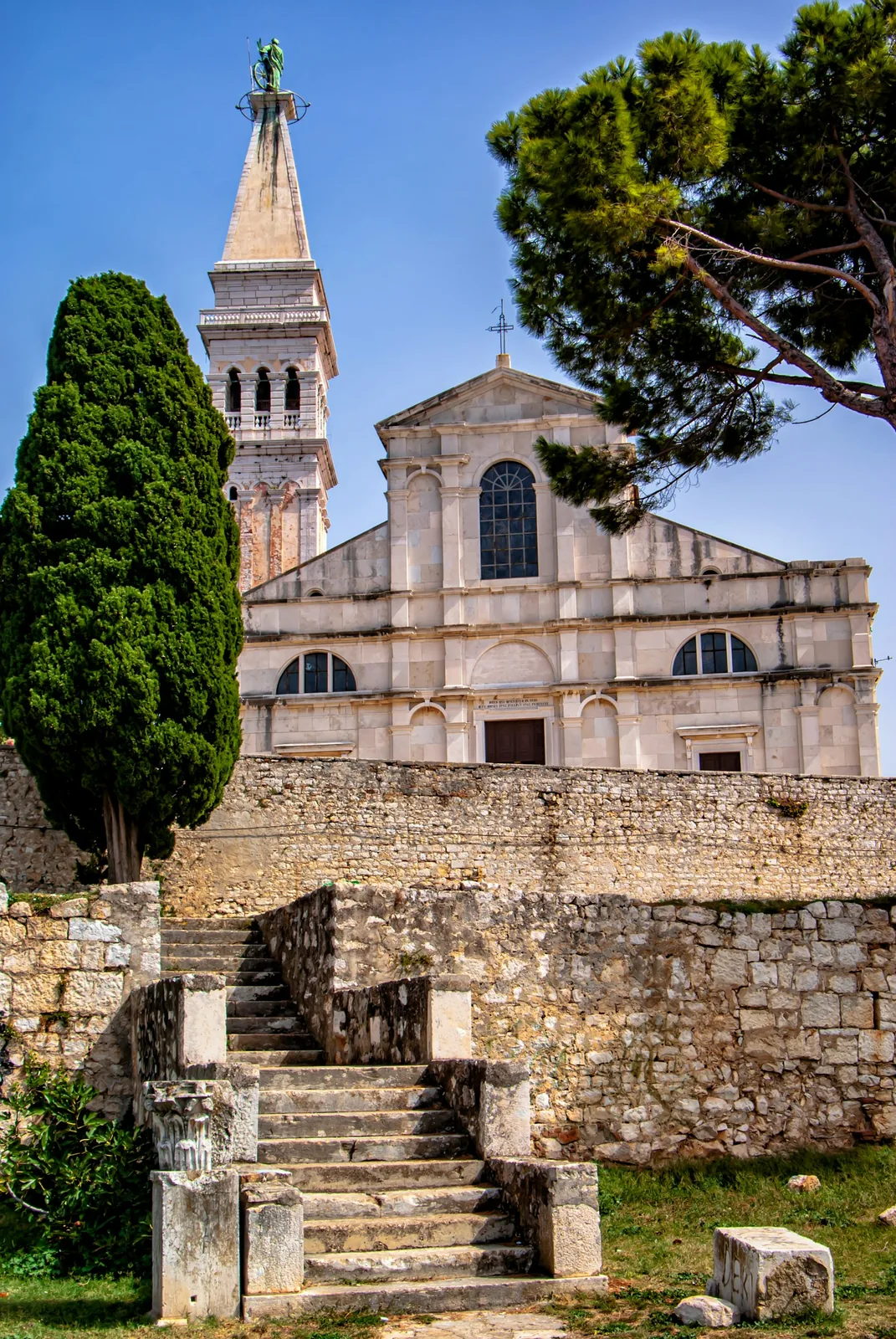
Don't rush back down after visiting. The plateau — the flat paved area around the church — was built in the early 1700s as part of the Baroque reconstruction, and the massive retaining wall on the south side used to anchor Rovinj's main cemetery. Graves were still being added here into the late 19th century; you can still see some of the numbered gravestones (I to XVI) paid for by Rovinj's 18th-century benefactor clergyman Olivier Constantini.
The views from the plateau alone — without climbing the tower — are worth the walk up. In summer it's a popular spot for sunset; in winter it's usually empty. Bring a water bottle if you're coming in July-August — the walk up Grisia and Bregovita streets is uphill the whole way.
When to visit
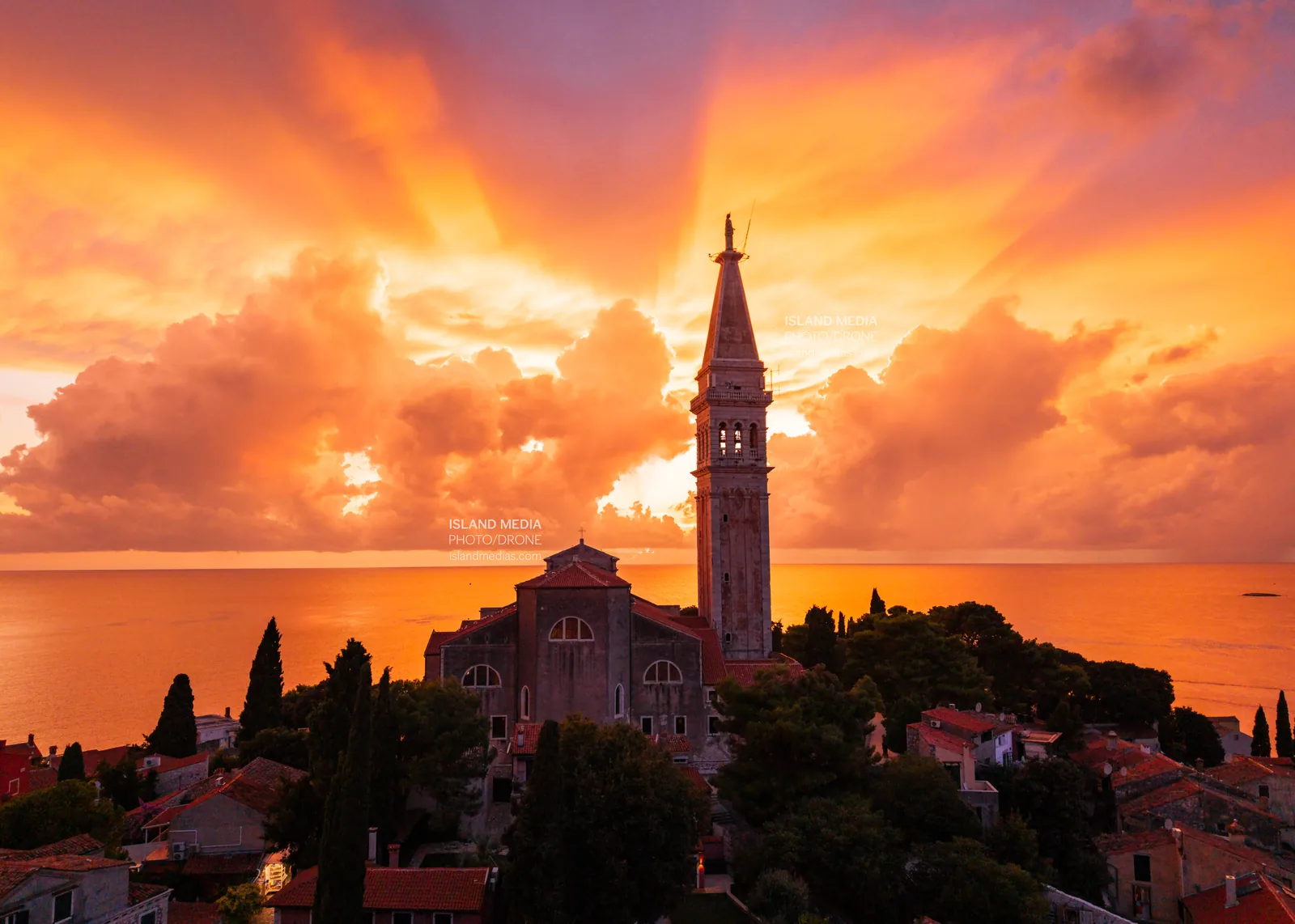
- Best time of day: early morning (cool, few people, good light for photos inside) or late afternoon (golden-hour light on the tower).
- The feast of St. Euphemia — 16 September — is the town's biggest day: a morning procession with the saint's relics, a solemn mass, and an all-day town festival. If you can be in Rovinj on that date, do it.
- Avoid midday in July and August unless you're fine with crowds on the tower staircase.
- Winter: the church is open but with shorter hours, and the climb may be closed if there's ice on the steps. Check in advance.
Local tip
Stop at the plateau before you climb the tower — the first view of the town, framed by the cemetery wall and a row of pine trees, is the one that makes people gasp. Climb the tower after. It's the opposite order of most tourists, and you'll have the plateau to yourself for a minute.
Also: look up at the statue before you climb. If she's facing the open sea, the weather's settled. If she's turned toward the town, pack a jacket.
Practical tips
- Entry to the church: free.
- Tower climb: fee payable at the door.
- Hours: broadly 10:00–18:00 in high season, shorter in winter. Tower closes before the church.
- Dress code: it's an active parish church. Covered shoulders and knees. Hats off inside.
- Getting there: walk up Grisia Street from the harbour, or Bregovita Street from Carera. Both are pedestrian-only and steeply uphill the last 100 metres.
- Accessibility: the plateau is reachable only on foot via cobbled streets. The tower climb is not wheelchair-accessible.
Once you've climbed, wander back down through Grisia (the old town's artist street, lined with tiny galleries) and finish with a coffee on the harbour promenade. That's the classic Rovinj half-day, in the right order.
For more of the old town, see our Old Town Walking Guide. If you're planning a whole day, our Things to Do in Rovinj article has the rest of the list.