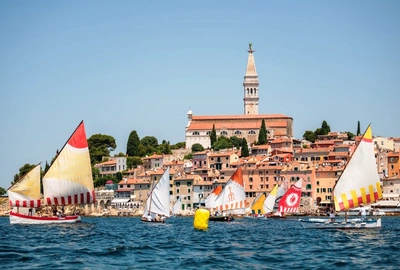
Every 16 September, Rovinj marks the feast of St. Euphemia, the town's patron saint and protector. It's also Dan Grada — Rovinj's City Day — so the religious events are wrapped in a broader civic celebration that runs all day. The week's programme usually starts around 11 September and culminates on the 16th.
The core tradition is over 1,200 years old. According to the legend, the saint's marble sarcophagus washed ashore at Rovinj on 13 July 800 AD — Benussi records the date in his 1888 history — after mysteriously disappearing during a storm from her church in Constantinople. Locals tell how two oxen guided by a young man dragged the heavy sarcophagus up the hill to the church that still bears her name. The earliest written version of this story survives in a 13th-century parchment codex — the Translatio Corporis Sanctae Euphemiae — preserved in Rovinj's capitular archive.
Who St. Euphemia was
Born in the late 3rd century in Chalcedon (across the Bosphorus from modern Istanbul), daughter of a patrician family. She was arrested during the Diocletianic persecution for refusing to renounce her faith and martyred around the age of 15. The traditional Passio describes a sequence of tortures — the wheel, fire, stones — before she was thrown to wild beasts in the arena; that's what finally killed her. In iconography she's shown with a palm (martyr), a wheel, and lions. Her feast is celebrated on 16 September, the traditional date of her death (c. 303–304 AD).
A great martyrium was later built over her tomb in Chalcedon; in 451 AD it hosted the Ecumenical Council of Chalcedon, one of the defining councils of early Christianity. Her sarcophagus moved to Constantinople, and from there — in the version told in Rovinj — it vanished one stormy night in 800 AD and came ashore on the Rovinj coast. The sarcophagus itself is of Proconnesian marble, Roman workmanship from the early centuries AD, roughly 2.08 m long, 0.95 m wide, 1.96 m high. It sits behind the side altar of the chapel dedicated to her, inside the Church of St. Euphemia.
Local tradition remembers that the Genoese took the relics during the long Venetian–Genoese wars of the late 14th century, and that Venice eventually returned them — an episode retold for centuries in Rovinj even if the exact dates are disputed in the historical record.
What happens on the day
The day is one real thing — patron saint + city day woven together. A rough shape of the 16th (the parish and the tourist board publish the exact programme in the days before):
- The sarcophagus is opened inside the Church of St. Euphemia so pilgrims can pray before the relics — the central Rovinj tradition of the day, going back over a millennium.
- Four masses in the church: a quiet morning mass around 08:00, a 09:00 mass in Italian (the parish is bilingual), an 11:00 solemn mass presided over by the bishop with the parish choir, and an evening mass around 18:00. Dress respectfully — covered shoulders and knees.
- Traditional crafts fair on the Riva, roughly 09:00–21:00: stone, wood, fabric, small producers from the wider region.
- Gastronomy at Veliki Mol, organised by the Batana Ecomuseum, usually around 11:30–13:30 — the traditional feast-day dishes are lamb with sauerkraut (ovčetina s kiselim zeljem) and fritule.
- Music on the squares — Mali Mol, Veliki Mol and the main square — through the afternoon and evening.
- Church façade lit in the evening with projections telling the legend of St. Euphemia — a modern addition that's worth staying for.
For the official schedule closer to the date, check rovinj-rovigno.hr and rovinj-tourism.com.
Why it matters
If you want to see Rovinj as the town it actually is — not a backdrop for photos — the Feast of St. Euphemia is the day. The religious core is unself-conscious and community-centred; it's not performed for tourists, though tourists are welcome to stand, watch, and (if you join a mass) participate respectfully. 1,200+ years of continuous veneration is a long time for any tradition to survive intact.
The saint herself still watches over the town from the top of the bell tower — a 3.9 m copper statue hammered into shape in 1758 by Vincenzo and Giovanni Battista Vallani of Maniago, two brothers. She's mounted on a pivot and turns with the wind — locals read the direction as a weather omen, and still glance up at her before heading out on the water.
Honest framing
This is a one-day civic + religious event, not a multi-day festival. The core religious moments are in the morning and early afternoon; the crafts fair, music and evening projections carry on later. If you're already visiting in mid-September — which is the best weather of the year in Rovinj — the 16th is the day to be in town. If your dates are flexible and you care about the heritage side of Rovinj, plan around the 16th rather than the early-September commercial Eufemia Festival.
For fuller monthly calibration, see our Best Time to Visit Rovinj guide.