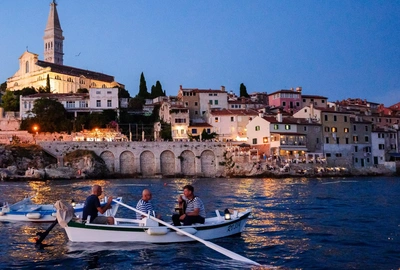
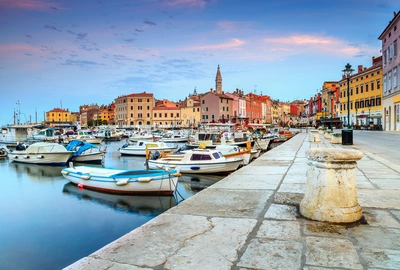
Rovinj looks older than it is, in the best way. The peninsula you walk through today — bell tower at the top of the hill, stone alleys falling toward the sea — has been one shape for only about 260 years. Before 1763 it was an island, separated from the mainland by a narrow channel. Before the Venetians arrived in the 13th century, it was a fortified hill settlement on a Roman road. Before the Romans, Illyrian tribes lived here.
This is a short honest history — enough to orient a visit, not enough to substitute for a proper book. For deeper reading, Bernardo Benussi's Storia documentata di Rovigno (1888) is still the standard.
What's in this guide:
- Origins: Illyrian, Roman, Byzantine
- Under Venice: 1283–1797
- The island becomes a peninsula (1763)
- Austrian and Italian periods: 1797–1947
- The Esodo and the Yugoslav era
- Modern Rovinj: independence and tourism
- The languages of Rovinj — Croatian, Italian, Istriot
- The batana and Rovinj's UNESCO heritage
- St. Euphemia, St. George, and the bell tower
- Where to see the history on the ground
Origins: Illyrian, Roman, Byzantine
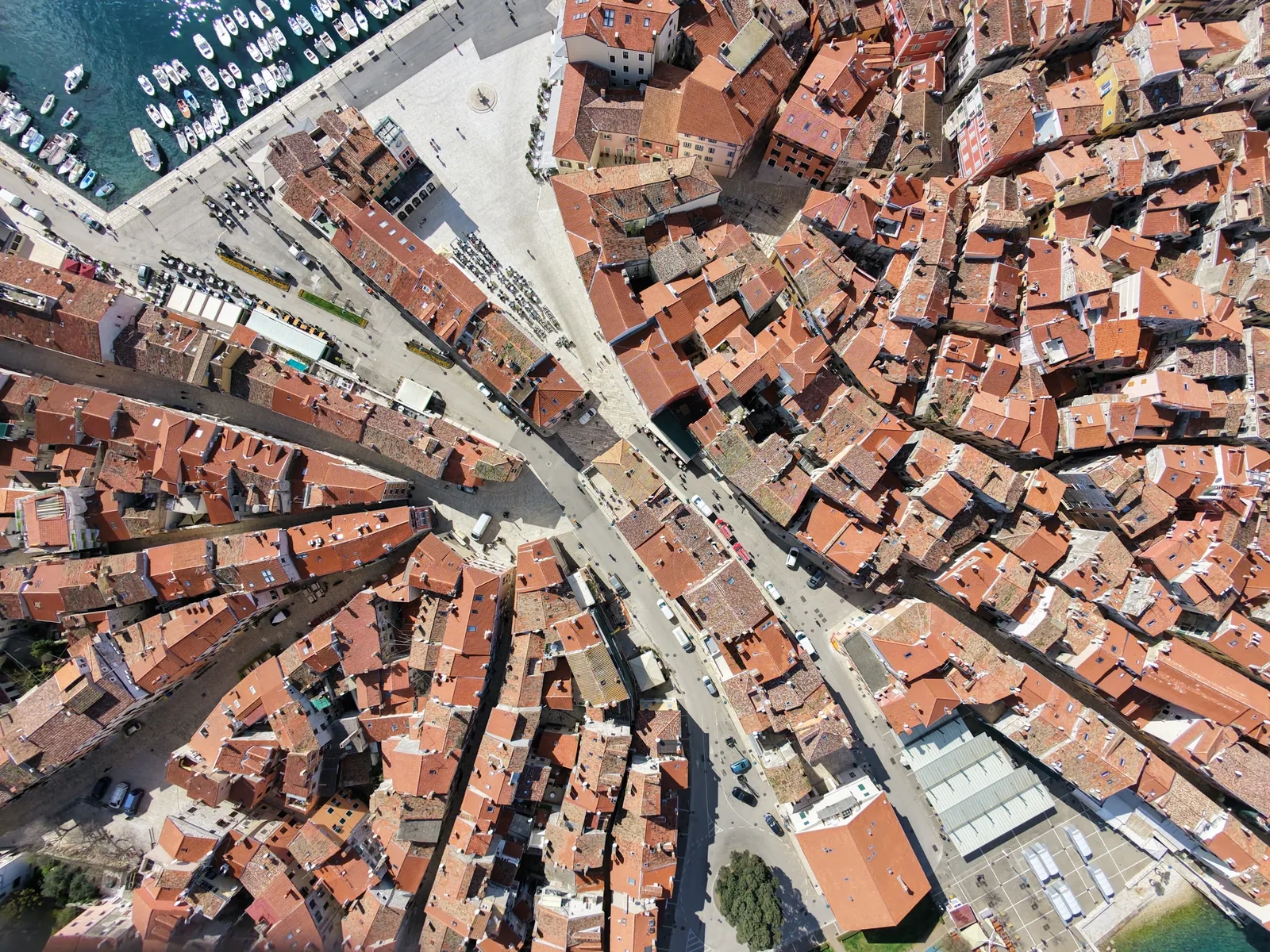
The human story on this stretch of coast goes back at least to the Bronze Age — the nearby Monkodonja hill fort, about 7 km inland, was already a stone-walled settlement around 1800 BC. What became Rovinj itself probably developed on a smaller prehistoric fort on the island where the Old Town stands, with continuous occupation from the 3rd to 5th centuries AD.
The Romans called the place Mons Rubineus and later Ruginium or Ruvinium. One likely source for the name is a Roman prefect called Rufinius — the name sticks through the medieval Latin Rubinum and emerges in the 6th–7th century in the writings of Ravenna's Anonymous as Ruigno, Ruginio, Revingo. By the high medieval period you get the two names the town still holds: Rovinj in Croatian, Rovigno in Italian.
After Rome fell, the settlement passed under the Byzantines, became part of the Exarchate of Ravenna in the 6th century, was taken by the Frankish Empire in 788, and cycled through feudal lords for several centuries. In 1209 it came under the Patriarchate of Aquileia. None of these periods left much visible mark on the town you see today.
Under Venice: 1283–1797
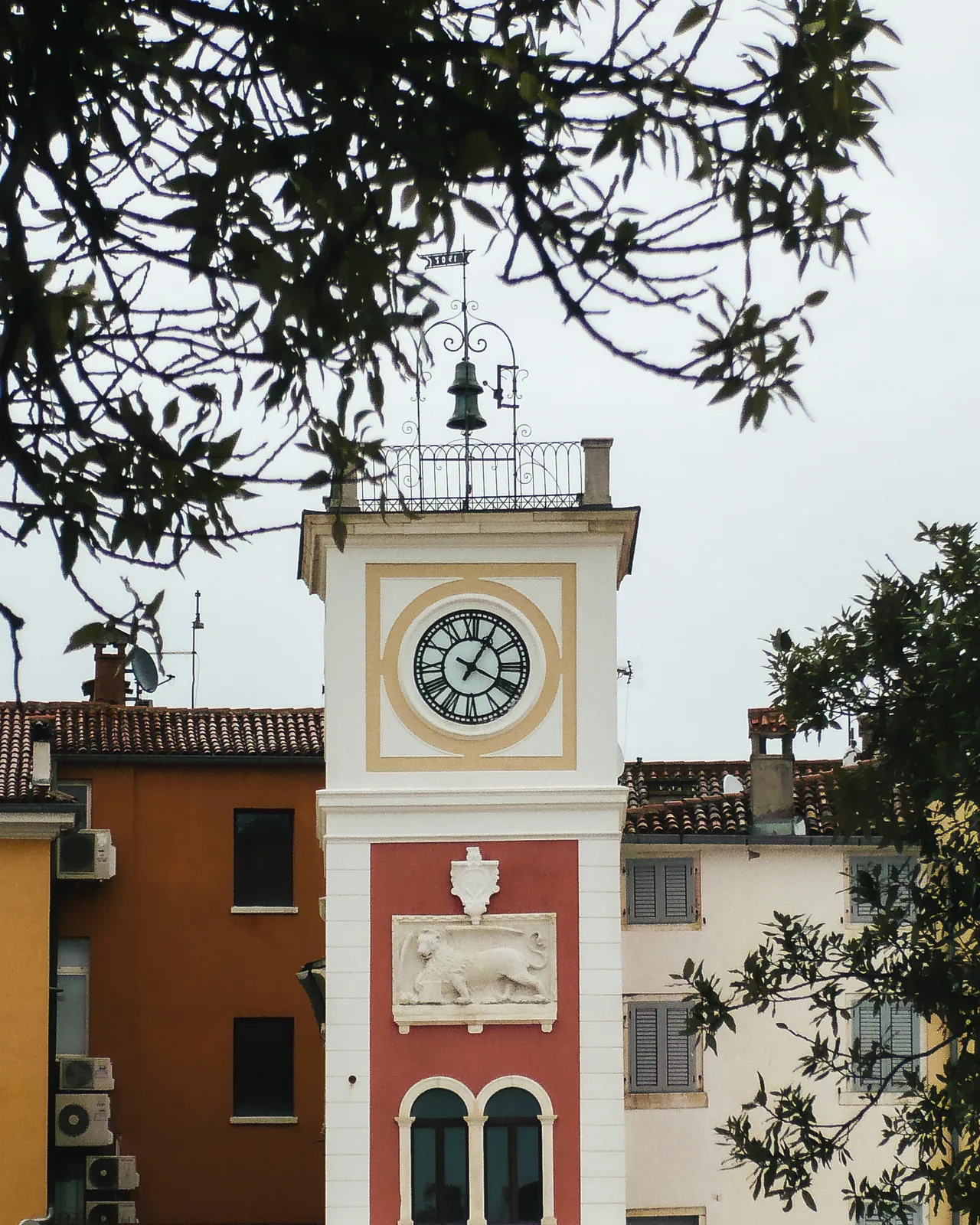
The defining era. Rovinj swore loyalty to the Republic of Venice in 1283, and stayed Venetian for 514 years. Almost everything you recognise as "Rovinj" in the Old Town was built, rebuilt, or shaped in this period.
Venetian Rovinj was a walled island town with three rows of defensive fortifications and seven gates. Three of the original gates still stand: the Gate of St. Benedict, the Portica, and the Gate of the Holy Cross. A fourth — Balbi's Arch (Balbijev luk / Arco dei Balbi), the ceremonial pedestrian entrance you pass through now — is a 1680 replacement built on the site of the old fish-market gate, commissioned under prefect Daniele Balbi's administration.
The town received its first city statute in 1531, codifying self-government under Venetian sovereignty. A 15th-century Venetian lion dated 1563 — the winged symbol of the Serenissima — is still mounted on the arch's façade, the Venetian side facing the old sea and "Venetian" side facing in toward town. (Francesco Almoro Balbi added a second lion sculpture in the 1870s, during the Austrian period — a nostalgic gesture to the Venetian past.)
Venetian Rovinj was unusually prosperous compared to the rest of Istria. While the 16th and 17th centuries hit Istrian towns hard with plague and war, Rovinj's island position made it easier to quarantine and defend. By the second half of the 18th century more than 13,000 people lived in the historic core — one of the most populated towns on the whole Adriatic coast, denser than most places in Venice's own hinterland. There were no noble families to speak of; the population was fishermen, sailors, dockworkers, shipbuilders, stone-cutters. The town's old nickname — la popolana del mare, "the common folk of the sea" — comes from this.
The island becomes a peninsula (1763)
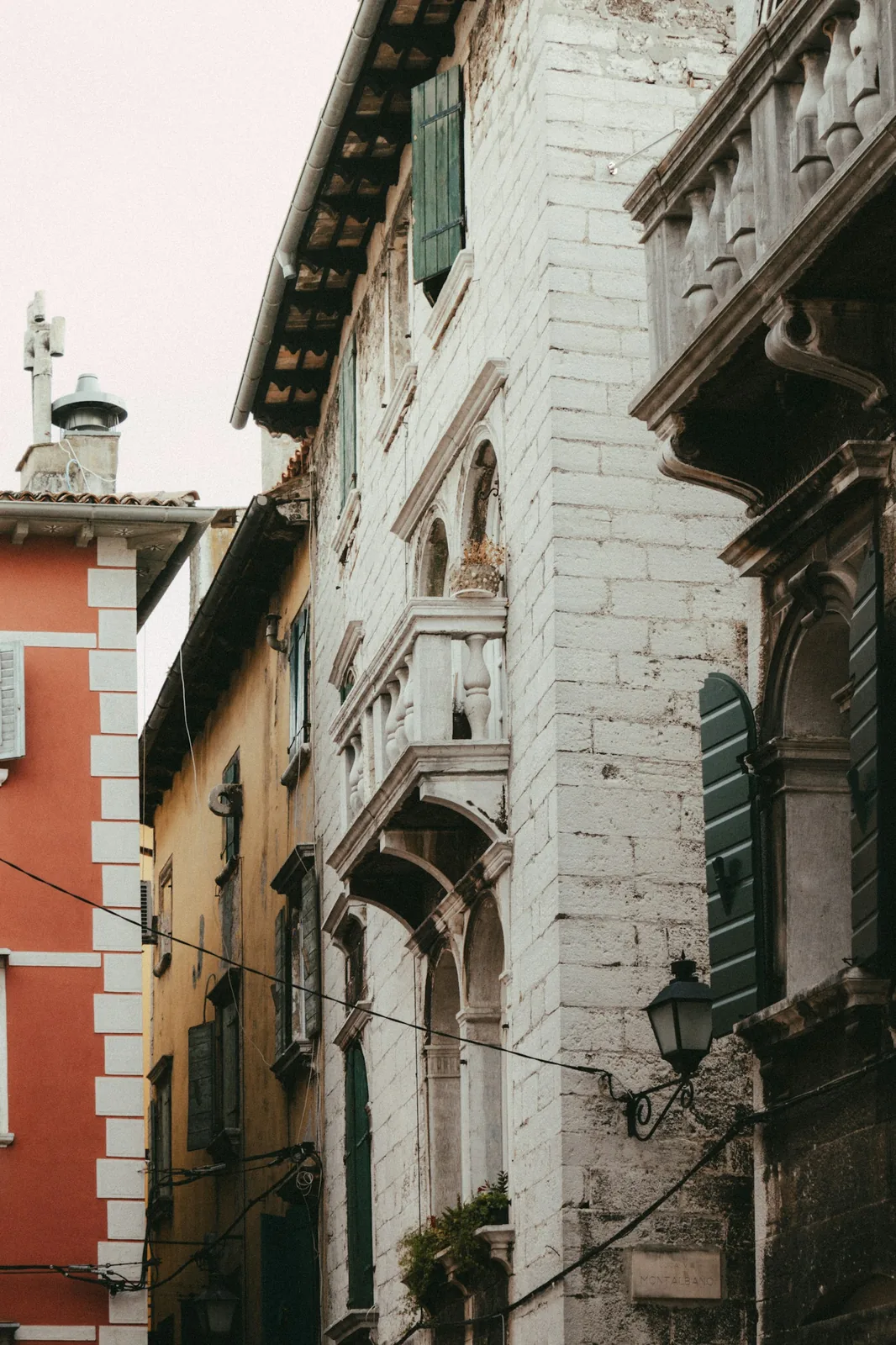
Rovinj stayed an island for roughly two thousand years. The narrow channel between the Old Town and the mainland was a natural defence, a fishing ground, and — by the 18th century — a sanitation problem. In 1763, with the Republic of Venice's approval, the channel was filled in. A town that had been a fortress became a peninsula. The Old Town gained a wider approach; the mainland town — Carera Street, Trg Maršala Tita, the waterfront market — developed on and around the filled land.
This is the single most consequential urban event in Rovinj's history, and the reason the town still feels half-island, half-mainland. Everything on the Old Town side of Trg Maršala Tita is on what used to be water.
Austrian and Italian periods: 1797–1947
Napoleon ended Venetian Rovinj in 1797. After a brief French period, the town joined the Austrian Empire (later Austro-Hungarian), where it stayed until the empire's collapse in 1918. Under Austria, Rovinj's identity held: the town was overwhelmingly Italian-speaking (97.8% at the 1911 census), the fishing and shipbuilding economy continued, and a railway branch line from Kanfanar reached the town in 1876. The station buildings north of the centre still stand; the line itself was closed in 1966.
One useful figure to know from this era: Georg Hütterott (1852–1910), a Trieste-born industrialist of German descent who bought four of the Rovinj islands in 1890 and transformed the Punta Corrente peninsula into a landscaped forest park. Today it's Zlatni Rt Forest Park, probably the single most-visited piece of green space in Rovinj. Without Hütterott's private project, the headland would have been quarried or built on.
After World War I, Rovinj became part of the Kingdom of Italy (1918–1947). The town was Italianised in name and administration; this was the period when "Rovigno" became the formal name. Fascist-era Italian rule was harsh in Istria, and an anti-fascist partisan resistance organised here through the 1930s and into World War II.
The Esodo and the Yugoslav era
The Peace of Paris (1947) transferred Istria from Italy to Yugoslavia. What followed is one of the saddest chapters of 20th-century Istrian history: the Istrian-Dalmatian exodus — esodo in Italian. Between 1947 and the mid-1950s, most of Rovinj's Italian population emigrated, mainly to Italy and South America. A town that had been 97.8% Italian-speaking in 1911 had, by the end of the exodus, shifted demographically. The name officially reverted to Rovinj. Streets were renamed. The town's character changed materially.
The Italian community that remained — today around 11% of the population per the 2011 census — kept its institutions: Italian schools from kindergarten through high school, an Italian cultural centre (the Comunità degli Italiani "Pino Budicin"), Italian bilingual signage, Italian-language mass in some churches. This is why Rovinj is legally bilingual Croatian-Italian to this day, and why everyone you meet who grew up here can switch between the two languages without thinking.
The post-war decades under socialist Yugoslavia turned Rovinj from a fishing town into a tourism town. The big hotels were built in the 1960s–80s along the coast south of the Old Town. The fishing fleet shrank. Cement production at the Mirna factory (north of town) became a significant industry, then declined. Tourism eventually dominated.
Modern Rovinj: independence and tourism
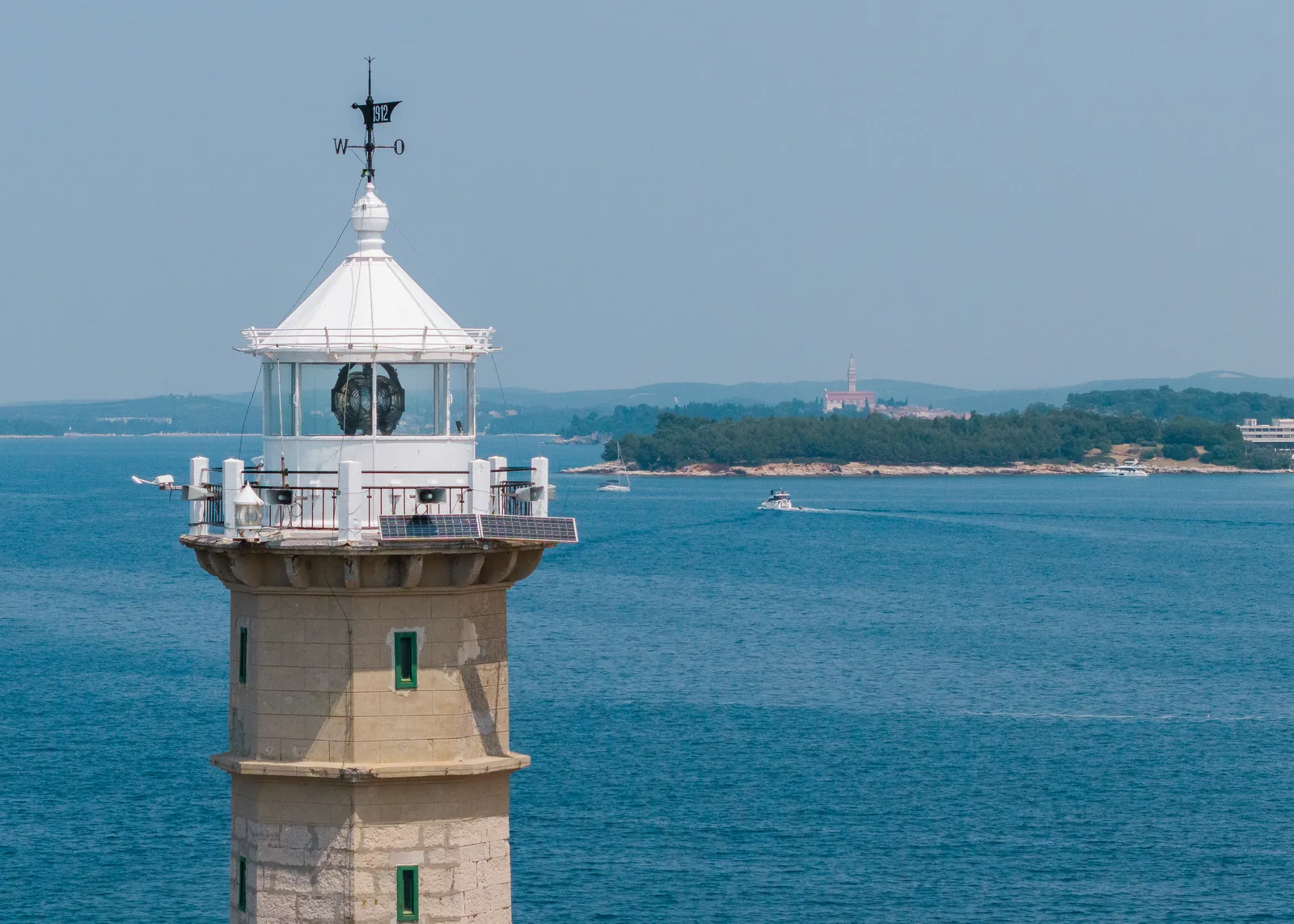
Croatia declared independence in 1991. Rovinj, spared the heavy fighting that devastated parts of eastern Croatia, continued as an Istrian tourism centre. Today the county of Istria is one of Croatia's wealthier regions — Rovinj is its second-largest tourism destination by overnight stays, behind Poreč.
Three 5-star hotels now operate in town — Hotel Monte Mulini, Hotel Lone, and the Grand Park Hotel Rovinj — all owned by Maistra, the local hotel group. Cruise ships anchor offshore near the northern harbour (Valdibora / sjeverna luka) through the summer and tender passengers in — they don't moor in Rovinj proper. The once-sleepy Carera Street runs as a pedestrian high street through the old Venetian town-within-a-town. The town is officially bilingual, economically tourism-dependent, demographically smaller than it once was — 12,968 people at the 2021 census, down from 14,294 in 2011.
The languages of Rovinj — Croatian, Italian, Istriot
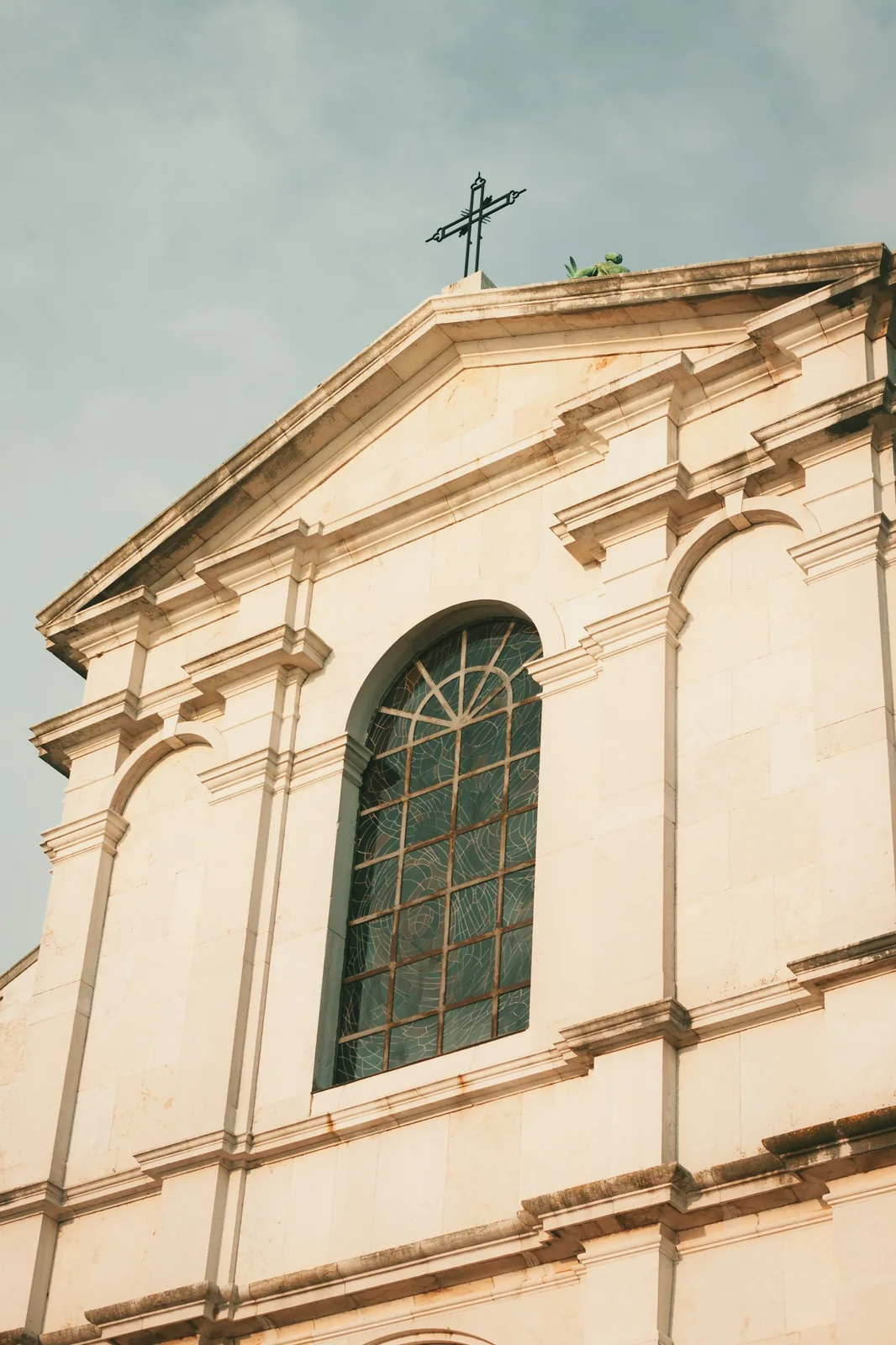
Officially, two languages: Croatian and Italian, equal and bilingual. In practice, there's a third you might hear if you're lucky: Istriot (bumbaro to some older locals). Istriot is a Romance language, related to Venetian and Dalmatian but a language of its own. It was once widely spoken across the western coast of Istria; today it's critically endangered, spoken fluently by perhaps a few hundred people in Rovinj, Vodnjan, Bale, Galižana, and Šišan.
You'll hear Istriot's fingerprints in the Rovinj dialect of Italian — local words and inflections that don't exist in mainland Italian. The Rovinj poet Eligio Zanini wrote in Istriot through the second half of the 20th century; his most-quoted line about his town is "oûn cantòn daparedeî∫" — "a corner of paradise." Another Istriot word you'll meet: bàva da tièra, the soft evening breeze that blows from the shore in summer.
If you're interested in Istriot specifically, the Italian cultural centre on Carera Street occasionally hosts readings and publications in the language.
The batana and Rovinj's UNESCO heritage
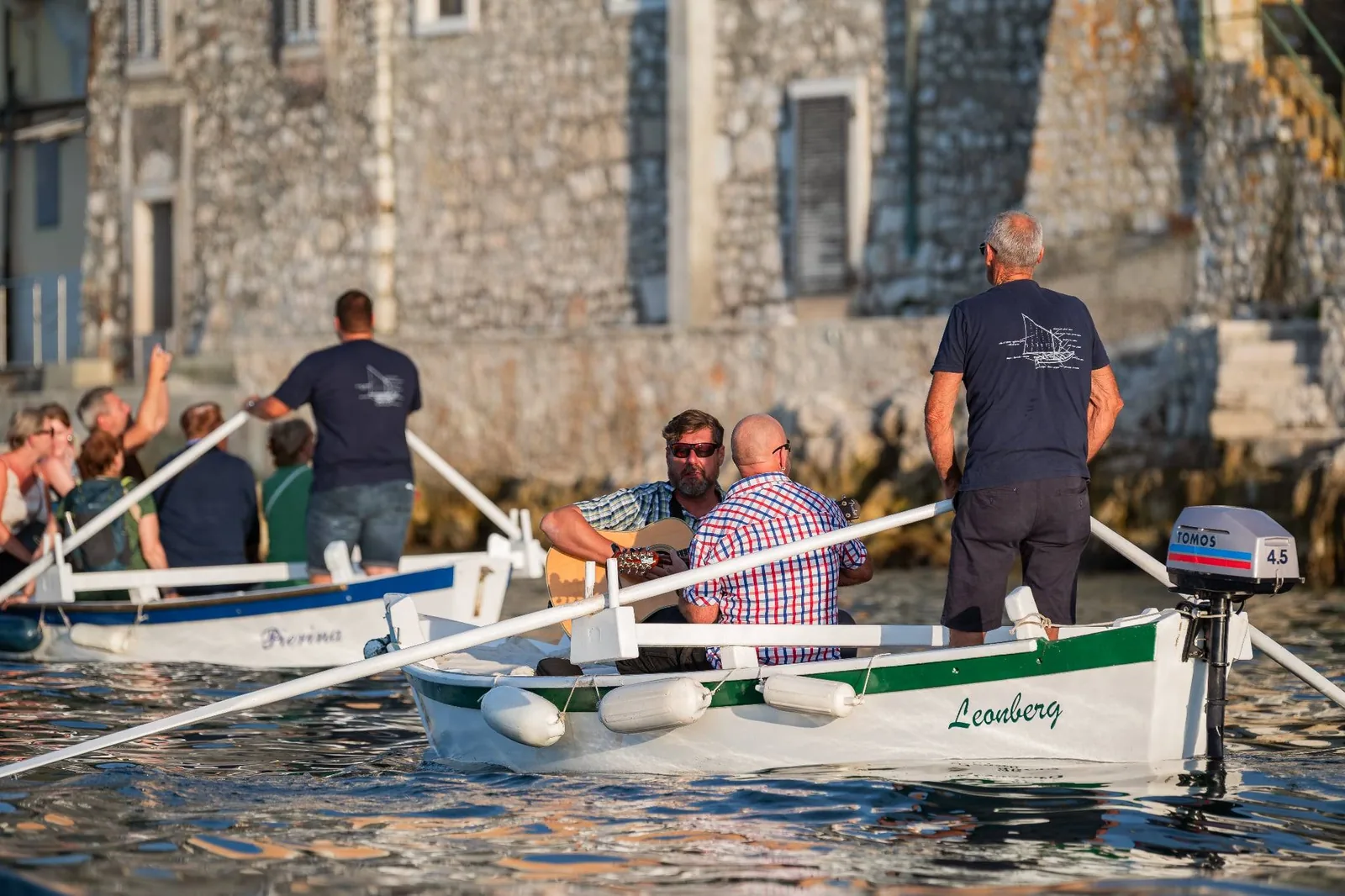
The single most distinctive thing about Rovinj culturally — the one thing UNESCO has officially recognised — is the batana. A batana is a flat-bottomed wooden fishing boat, traditionally rowed or sailed, painted in primary colours. They were the workhorses of the Rovinj fishing fleet for two centuries.
By the 1990s the batana was nearly extinct. A local NGO revived the tradition, built new boats using the old techniques, and opened Casa della Batana (Kuća o batani / the Batana House) — an ecomuseum on the waterfront dedicated to the boat, its language, and the fishermen's culture around it. In 2016, UNESCO added "The community of Rovinj and its batana boat" to its Representative List of the Intangible Cultural Heritage of Humanity.
The batana comes with its own song tradition too — bitinada, a kind of Rovinj folk polyphony where fishermen's voices fill in the melody line that an instrument might otherwise play. If you hear bitinada sung on a summer evening from a moored batana on Mandrač, you're hearing living UNESCO heritage.
St. Euphemia, St. George, and the bell tower
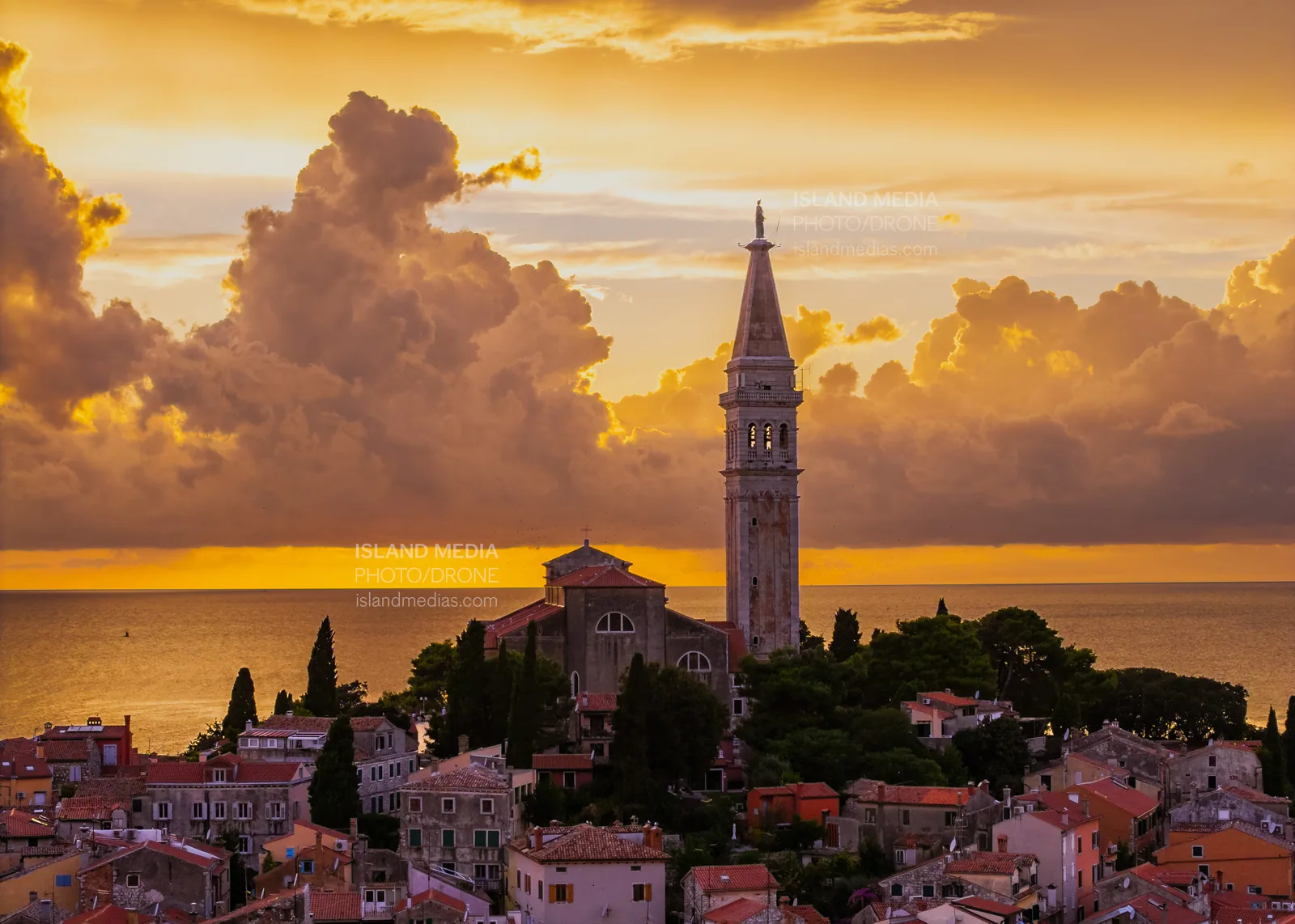
Two patron saints, not one. St. Euphemia is the famous one — a young Christian martyr who died in Chalcedon in 304 AD, whose sarcophagus is said to have floated up the Adriatic and landed in Rovinj in 800 AD, where it was adopted as the town's protector relic. Her feast day is 16 September, still the biggest night on the Rovinj calendar. The 4.7-metre copper statue on top of the bell tower, placed in 1758, rotates with the wind — locals read it as a weathervane, not just a saint.
The less-famous patron is St. George, present alongside Euphemia in the parish church's full dedication: the Church of St. Euphemia and St. George. He predates her as Rovinj's saint — the older medieval town had a Church of St. George on the hilltop before Euphemia's cult arrived.
The bell tower is the silhouette you see in every photograph of Rovinj. It was built between 1654 and 1687 — 33 years — to a design by the Milanese architect Alessandro Manopola, modelled closely on the Campanile di San Marco in Venice. At roughly 60 metres it's the tallest structure in town. You can climb it from inside the church; on a clear day you see the archipelago laid out like stepping stones and the Učka mountains on the mainland.
Where to see the history on the ground
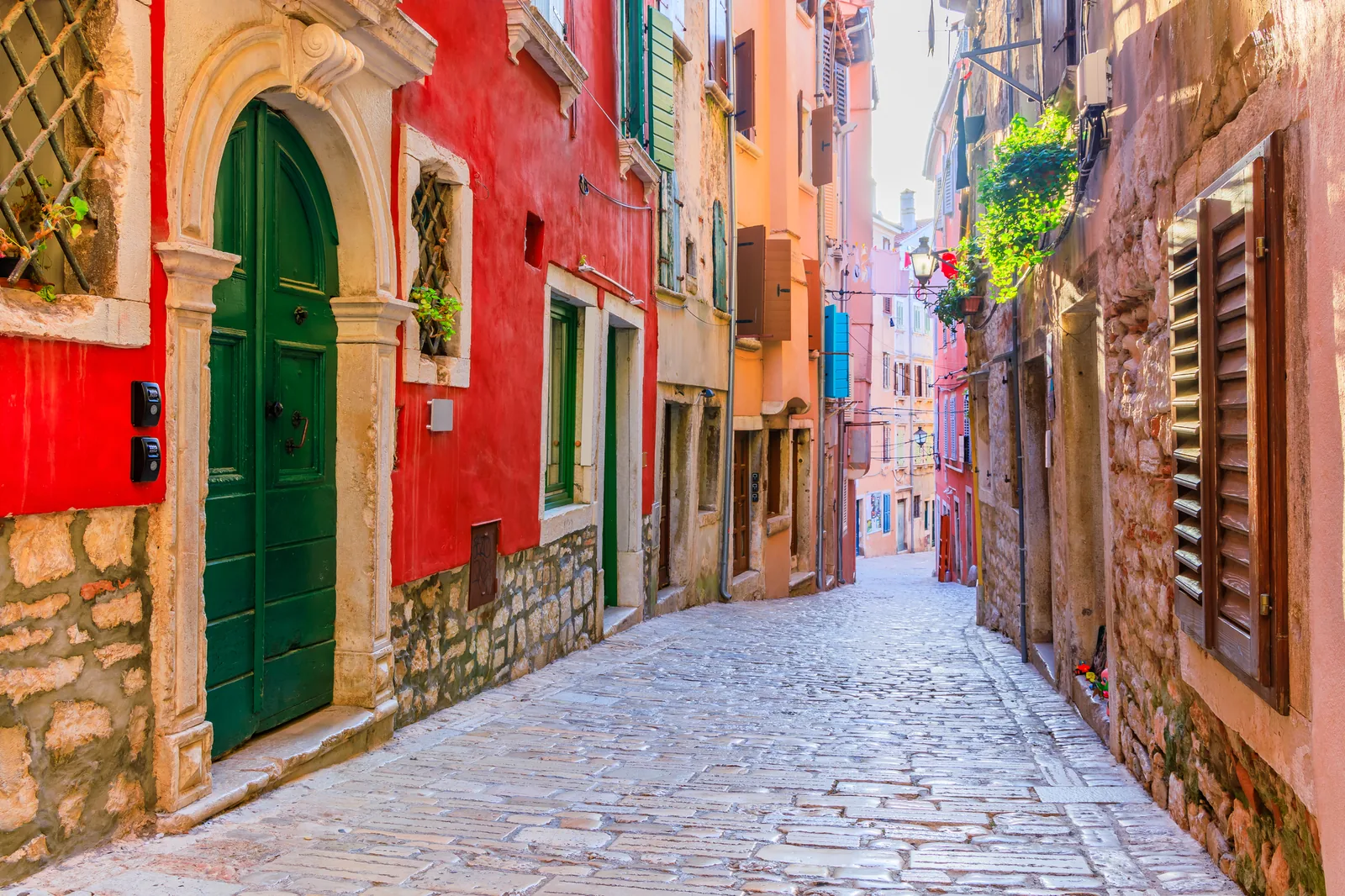
You don't need a museum ticket for most of it — Rovinj's history is the town itself. A few specific points that reward slowing down:
- Balbi's Arch + the surviving town gates — Balbi's Arch (1680), the Gate of St. Benedict, the Portica, the Gate of the Holy Cross. The Old Town walking guide routes you past all four.
- The Town Museum on Trg Maršala Tita — housed in the Baroque Califfi Palace, covers Rovinj's archaeology, fine art, and seafaring history. Small collection but high-quality for the size.
- Casa della Batana — the UNESCO ecomuseum, detailed guide here.
- Church of St. Euphemia and St. George — the sarcophagus, the ceiling paintings, and the bell-tower climb. Bell-tower guide.
- Grisia Street — the stone-paved street that climbs the hill toward the church, lined with artists' studios. Every second Sunday of August the entire street becomes an open-air art exhibition (the Grisia fair has been running since 1967).
- Punta Corrente / Zlatni Rt Forest Park — Hütterott's 1890 park. Park guide.
- Monkodonja Bronze Age hill fort — 7 km south-east of town, the prehistoric settlement that predates Rovinj by roughly 3,500 years. Free to visit, signposted.
- The Franciscan monastery and Church of St. Francis on the mainland side — one of the few surviving pieces of the original 18th-century "other side of the canal" settlement.
Two books worth reading if you're staying a while: Bernardo Benussi, Storia documentata di Rovigno (1888, available in Croatian translation as well as the Italian original) — the standard reference, densely historical. And Antonio Pellizer's shorter modern essays on Rovinj's Italian-speaking culture — warmer, more personal, written from inside the community.
The thing to keep in mind while you walk: Rovinj has been many towns — Illyrian, Roman, Byzantine, Frankish, Aquileian, Venetian, Austrian, Italian, Yugoslav, Croatian. Almost every stone you touch was laid by one of those earlier Rovinjs. The town's unity isn't ethnic or political — it's the shape, the sea it sits in, and the people who have stayed through every change of flag.